
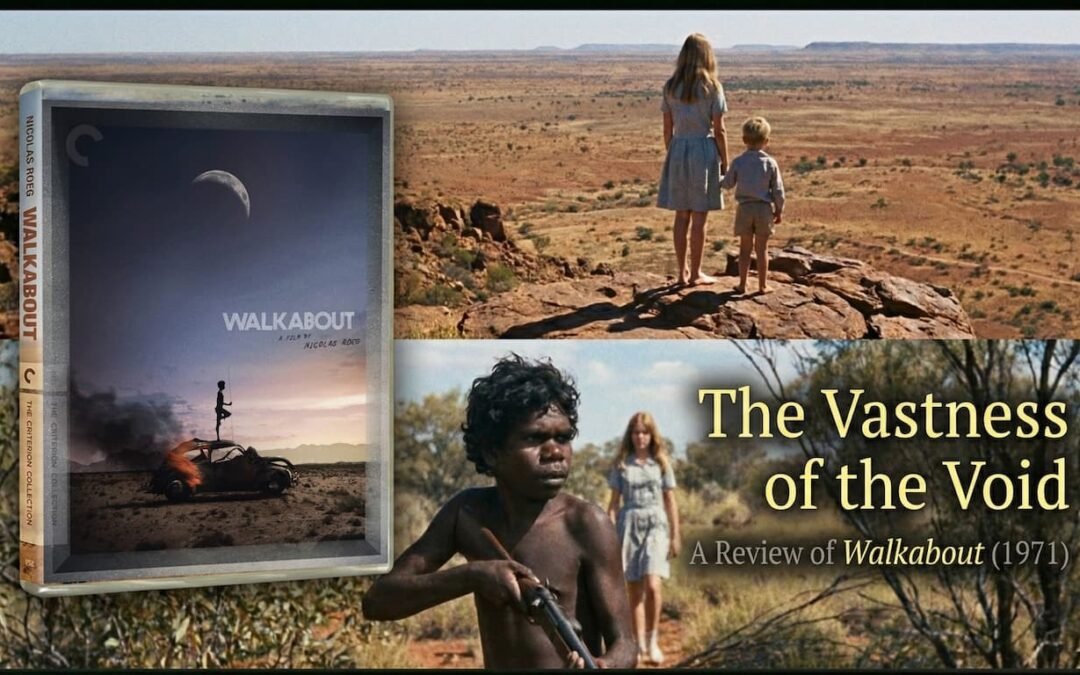
The Vastness of the Void
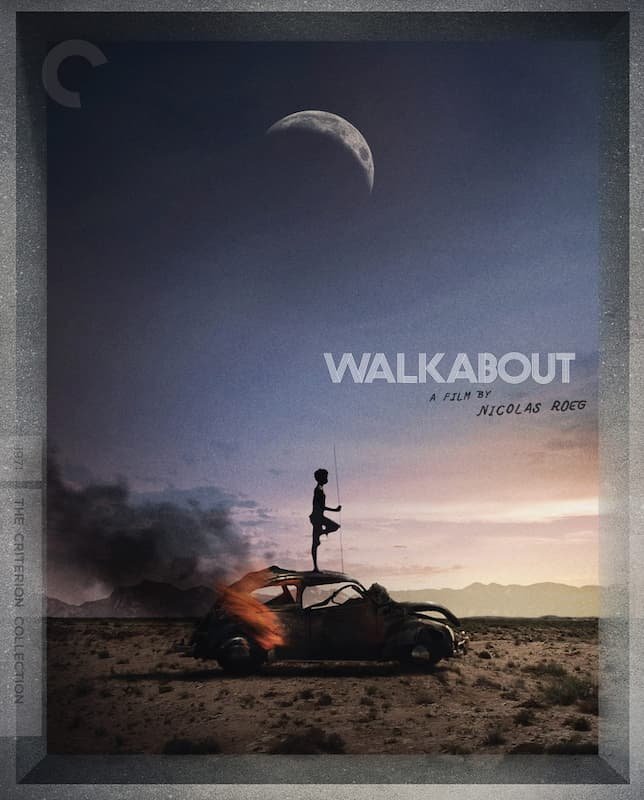
Spine #10 takes us to the Australian Outback, a setting so massive and ancient that it seems to swallow the characters whole. Nicolas Roeg’s Walkabout (1971) is less a survival story and more a meditation on the sheer scale of the Earth and how it overpowers even the most tragic human situations.
The film begins with a horrific event—a father attempting to murder his children before killing himself—yet Roeg films it with a terrifying distance. As the car burns and the father dies, the camera pulls back to reveal the endless red desert. This doesn’t make the tragedy insignificant; rather, it paints a picture that tragic things go unnoticed all the time in the natural world. Roeg intercuts the human drama with close-ups of dead animals and the bugs that consume them, reminding us that in this space, death is just part of the landscape. It happens, and life moves on.
This environment also strips away the illusions of “civilized” superiority. The two white children, pampered and dressed in school uniforms, quickly become “fish out of water.”
In this shared space, the social hierarchy flips. The Aboriginal boy, who would be an outcast in the city, becomes the leader and the savant. He is the only one equipped to read the map of the earth. It is a powerful reminder that every person who has ever lived is walking their own path on the same planet, but our understanding of that planet is entirely defined by our experience.
The Verdict: Walkabout is a visually stunning, hypnotic film that humbles the viewer. It uses the vastness of natural space to show us that our “civilized” tragedies are just small ripples in a very large, very indifferent ocean of sand.
Related Posts
Review: Nanook of the North (Spine #33)
The Reality of the Hunt Spine #33 takes us all the way back to 1922 for Robert Flaherty’s Nanook of the North, widely…

Reel Terror: My Bloody Valentine Review
How refreshing is ‘My Bloody Valentine’? Here’s what I had in my corner going in: A slasher flick with a cringe…
0 Comments