
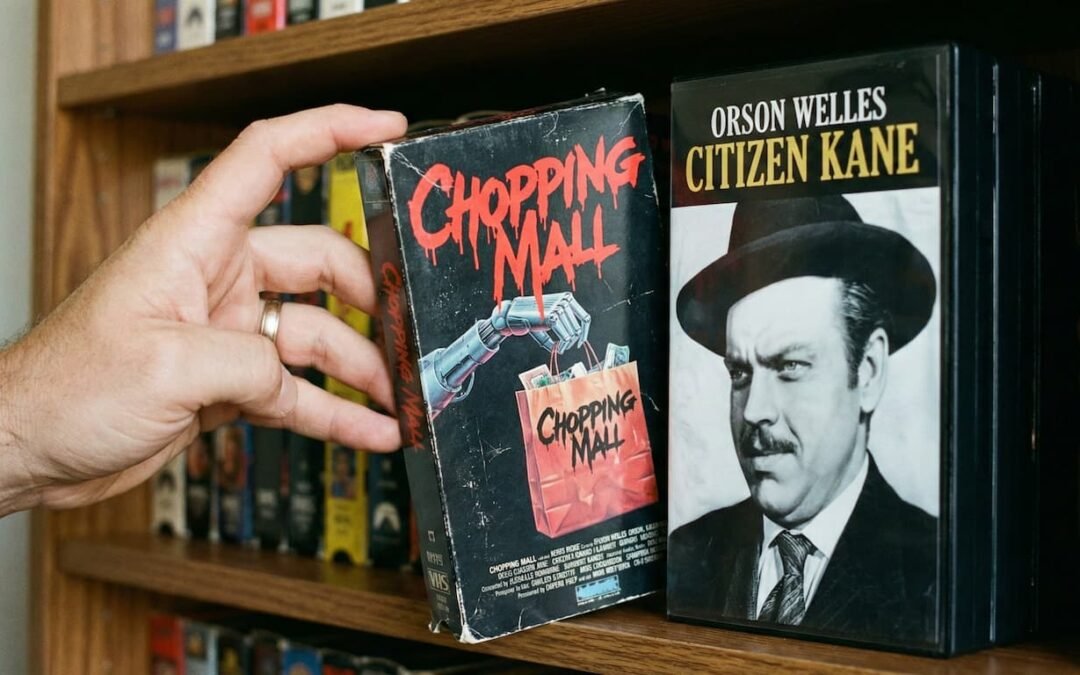
It’s Friday night. You scroll past the multi-hour historical epic that just won Best Picture. You ignore the gritty, desaturated documentary about societal collapse. Lord knows you skip the news. Instead, your cursor hovers over something else. Something bright, loud, maybe a little stupid, and absolutely wonderful.
You hit play on Chopping Mall.
For 77 minutes, you are entertained. You laugh at the killer security robots. You cheer for the stereotypical teens trapped in the mall. You are having a genuinely great time. Yet, if someone were to ask you on Monday, “What did you watch this weekend?” you might hesitate. You might preface your answer with a self-deprecating chuckle, a slight blush, and that dreadful, pervasive phrase: “Oh, just a guilty pleasure.”
Why? Why do we attach “guilt” to the feeling of pleasure?
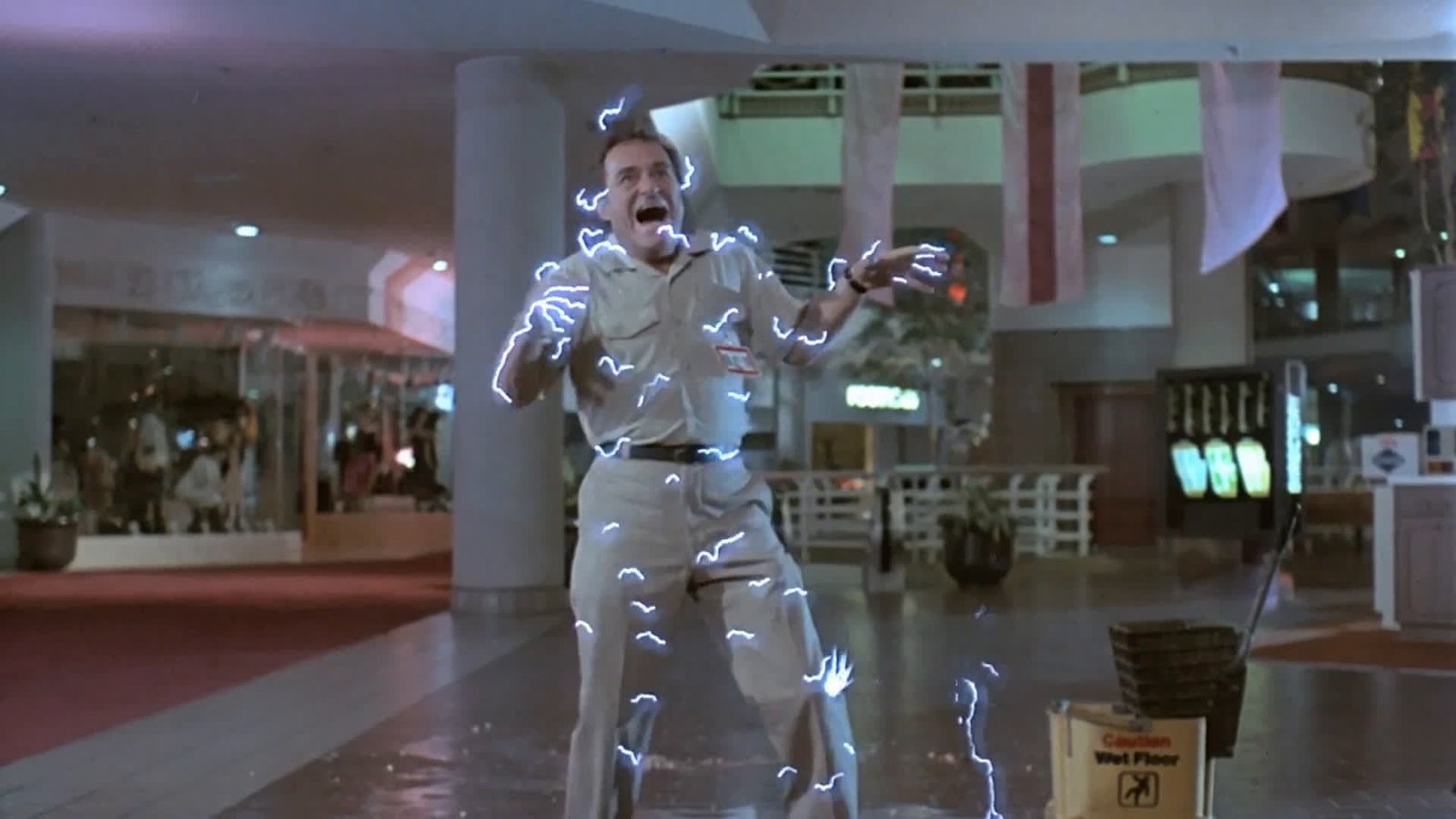
Who doesn’t want to watch Dick Miller get fake electrocuted?
For too long, film discourse has been dominated by a rigid hierarchy of taste. There is “Cinema” (capital C), which is serious, challenging, and important. And then there are “movies”—the B-horror flicks (like Waxwork), the campy sci-fi operas (like Tank Girl), the formulaic holiday romances (like The Knight Before Christmas). We are trained to believe that enjoying the latter makes us less sophisticated, less intelligent, or just plain deeply uncool.
It is time to retire the term “guilty pleasure” once and for all. If a piece of art makes you feel something—fear, glee, silliness, comfort, or adrenaline—then it has done its job. And you should never apologize for the joy it provides.
The Validity of the Visceral Reaction
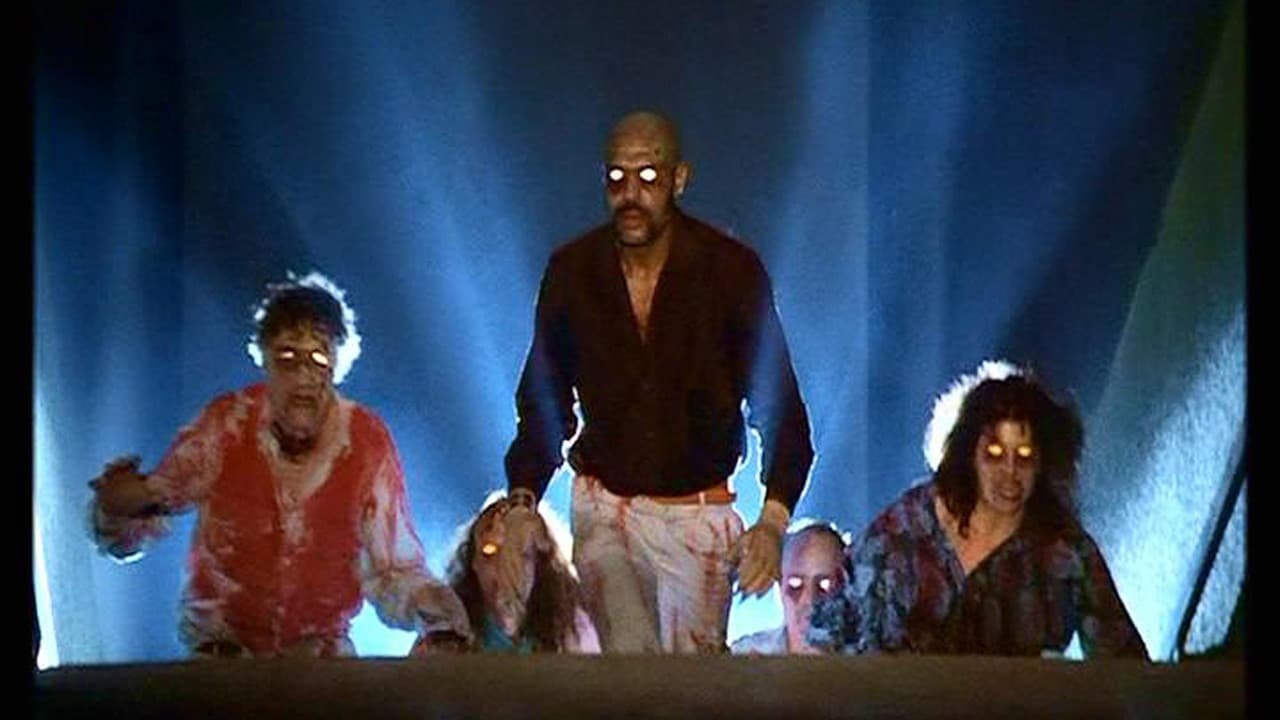
This is WAY cooler than Peter O’Toole on a camel!
The fundamental flaw in the “guilty pleasure” label is the assumption that the only valid emotional response to film is intellectual stimulation or profound sadness. This ignores the entire spectrum of human experience that B-cinema taps into so brilliantly.
Cinema is a primal medium. It hits our eyes and ears and goes straight to the gut. When you watch Flash Gordon (1980), you aren’t looking for sophisticated political commentary. You are there for the eye-popping colors, the gloriously hammy performances, and that thumping Queen soundtrack (and Princess Aura…wowza!). It is the combination of camp that makes you feel wildly, childishly happy. Why should anyone feel guilty about that?
The same applies to horror. A movie like Witchboard or Demons might not have the artistic merit of The Exorcist, but it delivers a specific, fun atmosphere of 80s schlock that is uniquely satisfying on a dark, rainy night (or any night, really). The fear, the jump scares, the ridiculous fashion—these evoke real physical and emotional reactions. If a movie succeeds in making you feel the way it intended to make you feel, it is a successful film. Period.
Respecting the Craft of the ‘B-Movie’

Maybe not as cool as Peter O’Toole on a camel…but there’s bottle flipping!
When we dismiss a film as a mere “guilty pleasure,” we are often dismissing the immense amount of work, passion, and creativity that went into making it.
Making a movie is incredibly difficult. Even a “bad” movie requires dozens (if not hundreds) of people working long hours, solving complex problems, and pouring their energy into a shared vision. B-cinema is often characterized by low budgets and high concepts, which forces filmmakers to be incredibly inventive. Filmmakers don’t have to think too hard when they there is a seemingly unlimited budget!
Look at the practical effects in The Evil Dead, the intricate set designs of a low-budget sci-fi epic like Dark Star, or the razor-sharp comedic timing of a cult classic like Clue (which was criminally underappreciated in its time). These aren’t accidents. They are the result of passionate creators swinging for the fences.
Sometimes they miss. Sometimes the acting is wooden, or the monster looks like a rubber suit. But there is often more sincerity in a flawed B-movie than in a calculated, paint-by-numbers blockbuster. We should celebrate that audacity, not hide our appreciation for it.
Comfort is Not a Crime

Have you seen this one?
Perhaps the most unfairly maligned genre in the “guilty pleasure” canon is the Hallmark Christmas movie. They are easy to mock. The plots are identical. The small towns are impossibly quaint. They all use stock video with snowy overlays.
But to label the millions of people who watch them as having “bad taste” is lazy and unfair. In a world that is often chaotic, stressful, and scary (again – avoid the news), these films offer 90 minutes of guaranteed safety. You know everything is going to work out. They are the film form of a cup of hot chocolate. Feeling comforted is a valid human need, and if a movie provides that, it is valuable. You don’t need to feel guilty for wanting a hug in movie form.
Own Your Joy
Ultimately, taste is subjective, but joy is universal. The concept of the “guilty pleasure” is gatekeeping; it is just a way to make people feel insecure about what entertains them.
It’s time to stop performing “good taste” for an imaginary audience of film critics. If you love the anarchic energy of killer robots in a shopping mall, own it. If the baroque insanity of 80s sci-fi makes your heart sing, shout it from the rooftops.
A “good movie” isn’t just one that wins awards or changes the medium landscape. A good movie is one that you enjoy watching. Let’s drop the guilt and keep the pleasure.
What movies do you love to love? Let us know in the comments!
2 Comments
Submit a Comment
Related Posts
Review: Alphaville (Spine #25)
The Emperor’s New Sci-Fi Sometimes, a film is a profound exploration of society, and sometimes, it is exactly what it…
Review: High and Low (Spine #24)
The Morality of a Ransom For my second Kurosawa experience (after Seven Samurai ), High and Low (1963) trades the…
Own what you enjoy!
I’d sure a hell rather watch UHF than The English Patient!
Who wouldn’t?!?