
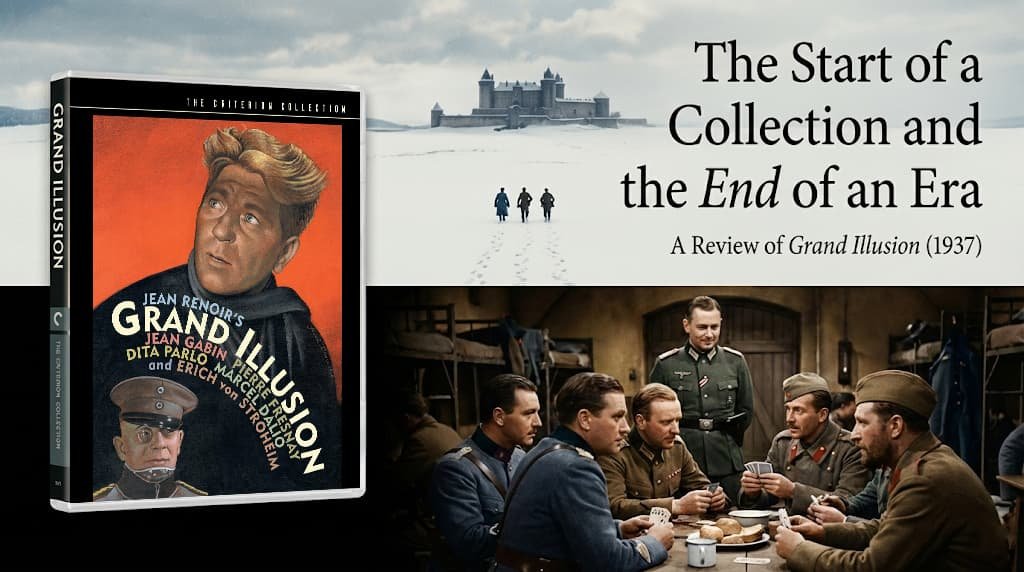
The Start of a Collection and the End of an Era
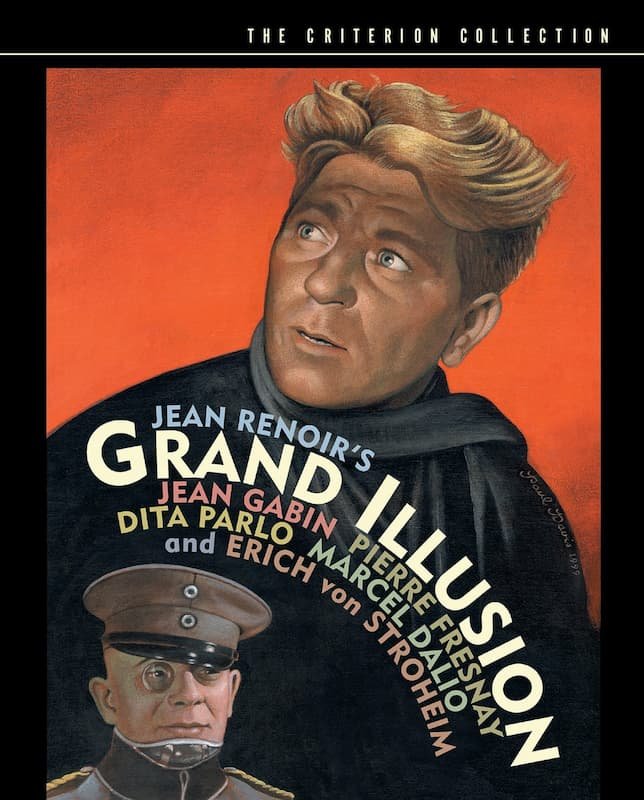
To start a journey through the Criterion Collection, one must start at the beginning. But Grand Illusion (1937) isn't just significant because it is Spine #1; it is significant because it operates as a mission statement for what cinema can be. It proves that film is not merely a tool for escaping reality, but a medium that can impact life itself.
The title has been debated for years, but watching it now, the "illusion" seems clear to me: it is the idea that war is justified, or that soldiers are anything other than ordinary men "pretending" to serve. Throughout the film, whether French, Russian, or German, the characters are defined less by their uniforms and more by the lives they are waiting to return to. They coexist with a surprising lack of hatred, united by the common desire to stop being soldiers and return to being human.
Director Jean Renoir famously posits that class divides men more than borders, and that geometry holds up beautifully here. The relationship between the German Captain Rauffenstein and the French Captain Boëldieu is one of tragic respect. They share a dying world of aristocracy, even switching to English when they want to hide their conversations from the "commoners" in the room.
Contrast this with the friendship between the mechanic Maréchal and the wealthy Jewish prisoner Rosenthal. Renoir visually highlights their bond through their shared "dirt." As they escape across the countryside, their messy, disheveled appearance signals that they are of the earth—grounded, human, and alive in a way the pristine, isolated aristocrats in the castle are not.
For a "war movie," there is a notable absence of battle scenes. Instead, it plays out as a prison escape film (a genre still thriving today), relying on psychological tension rather than explosions. It is startling to see how mature the camera work was in 1937; the movement has intent, taking us from claustrophobic interiors to wide, snowy landscapes.
Perhaps most striking is the film’s courage. Released on the brink of WWII, it dared to depict Germans as sympathetic human beings rather than monsters. It also placed Rosenthal, a Jewish character, at the moral center of the story—a bold move for 1937 Europe that feels tragically prescient.
The Verdict: Criterion likely chose this as their debut because it represents a cinema that is forgotten by too many: films that prioritize humanism over spectacle. Grand Illusion is a courageous, complex portrait of a world on the brink of change. It is an intimidating place to start the collection, but a necessary one.
Related Posts
Review: Nanook of the North (Spine #33)
The Reality of the Hunt Spine #33 takes us all the way back to 1922 for Robert Flaherty’s Nanook of the North, widely...
Reel Terror: My Bloody Valentine Review
How refreshing is ‘My Bloody Valentine’? Here’s what I had in my corner going in: A slasher flick with a cringe...
0 Comments